


Stationary traffic takes up a large proportion of the space in urban areas. Against the backdrop of the enormous increase in land requirements in recent years for housing, workplaces and infrastructure on the one hand, and more public open spaces and local recreation areas on the other, the question arises as to how to deal with the high land consumption of stationary traffic due to large parking areas.
A thorough assessment is crucial for the effective and multifunctional use of urban space. Our parking space analysis offers a powerful tool for this purpose: automated, comprehensive and data-based.
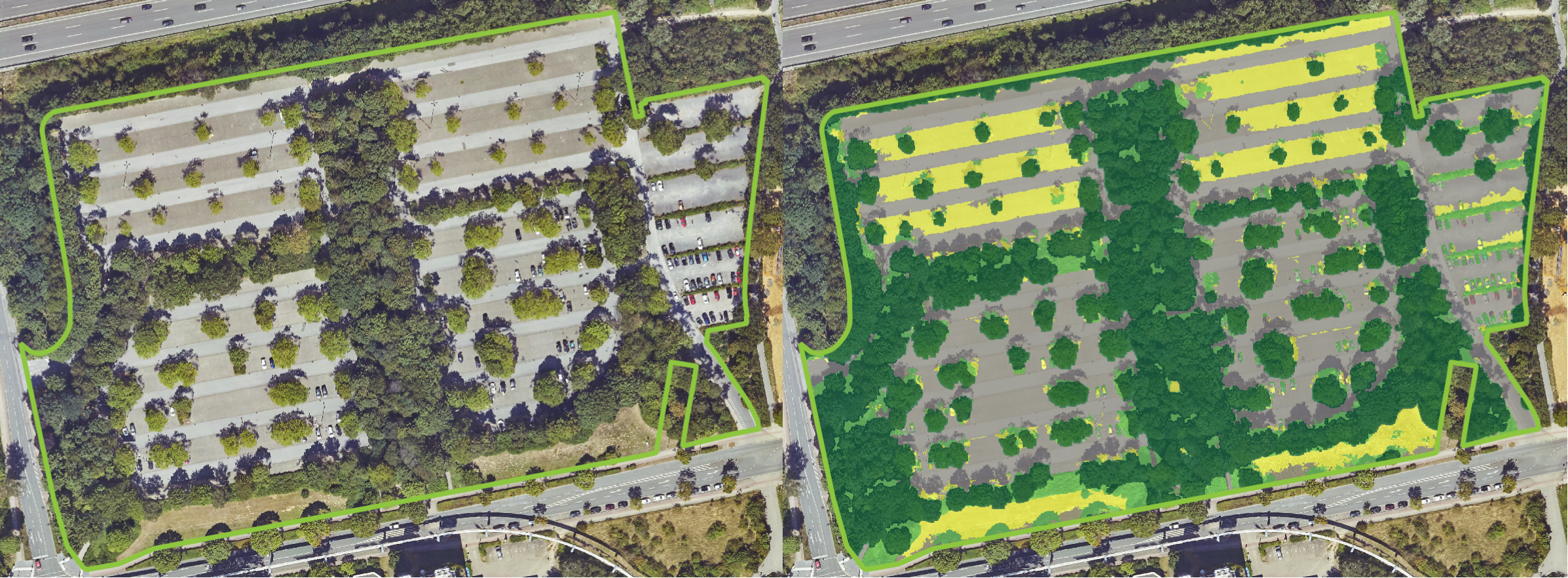
Our ‘Parking Space Analysis’ data package supports your informed decision-making in urban planning and environmental assessment.
The precise and comprehensive data analyses provide our customers with a solid basis for planning and environmental protection measures and enable complex environmental challenges to be tackled more efficiently.
Do you require parking space analyses for your city? Contact us!
Further information and publications on this topic:
FOSSGIS2024 presentation
Informationen from BBSR
Informationen from multiplicities
News from City of Dortmund
Article from stadtvonmorgen.de
Article from welt.de
Our parking space analysis includes data processing and analysis in four key areas:
Detection of parking areas: All relevant parking areas are automatically detected and identified as polygons.
Combination with cadastral data: Integration of ALKIS and OpenStreetMap for complete coverage.
Parking area characteristics: Information on size, compactness and number of parking spaces is provided.
Available extensions: Roadside parking spaces can also be included on request.
Sealed surfaces: Roads, paths, asphalt and other sealed surfaces are classified.
Unsealed surfaces
Vegetation: Classification of vegetation into ‘tall vegetation’ (trees) and ‘low vegetation’ (non-tree vegetation).
Buildings and Infrastructure
Water bodies: Detection of bodies of water in the parking area (e.g. ponds or lakes).
Data formats: The surface classification is provided as GeoTIFF or in vector form (GeoPackage).
Tree positions: Individual trees are automatically detected and provided as point vectors.
Tree height and crown diameter data: Calculation of tree height (maximum and 95% percentile) as well as crown diameter, area and volume (assuming a spherical crown).
Data base: Use of high-resolution point cloud and RGBI aerial survey data.
Degree of greening and environmental factors: Analysis of degree of greening, sealing and other environmental factors.
Surrounding information: Consideration of the surrounding building structure and proximity to nature reserves and protected landscapes.
Standard land values: Consideration of standard land values (where available) to evaluate economic potential.
Automated & comprehensive
Recording of all parking areas via geodata & remote sensing
Detailed Analysis
Parking spaces, sealing, greening, surroundings, land values
Individual tree detection including
trunk position, crown size, volume for climate analyses
Stanndardised parking space report
Clearly presented results for administration and planning
GIS-compatible
GeoPackage, GeoTIFF – can be integrated directly
Adaptable to local requirements
e.g. minimum sizes, data sources, classification depth